Gone Off 'The Wind' (1928)
What if 'Wuthering Heights,' but West Texas?

By Taylor Prewitt
An Americanism first documented in the 1820s, a so-called “norther” is a wind that blows in from the north, sometimes called a blue, or Texas, norther if particularly severe. In a 1990 column for the Victoria Advocate, writer Henry Wolff Jr. tried, and ultimately failed, to describe the weather phenomenon, saying instead, “every Texan knows about them.” Looking in library books, Wolff couldn’t find the weather phenomenon described and assumed that “northern writers don’t mention northers at all, as such, and I think the southern writers just take it for granted that we already know what [it] is.” The idea is that northers are so commonly Texan that they don’t warrant mention; you don’t describe water to a fish.
In 1928’s The Wind, a norther is so ubiquitous as to become the titular antagonist of the film, the driving force behind an 18-year-old woman’s descent into madness. Based on a 1925 book by Baylor University professor Dorothy Scarborough, the movie was of MGM’s final silent films and, released the same year as the first “talkie,” one of the last great works of a dying medium. Though it was originally panned by critics, it has since become well-respected; last month, Texas Monthly included the film in its updated list of the state’s greatest movies. When I learned that the film was set in Sweetwater—a small town with a “pleasant-sounding name” in which Kelsey and I also went slightly insane, and whose windy dustiness went remarked upon—I knew I had to see it.
The story begins with a stranger on a train—a plot device that would be used two decades later by one-time Texan Patricia Highsmith in fellow book-cum-film Strangers on a Train. In The Wind, the stranger is Wirt Roddy (Montagu Love), a slimy cattle buyer who we later learn is married. Like Leslie Lynnton of 1952’s Giant, our young protagonist, Letty Mason (Lillian Gish), is en route to Sweetwater from Virginia, to stay at her cousin’s ranch when Roddy approaches her on the train.
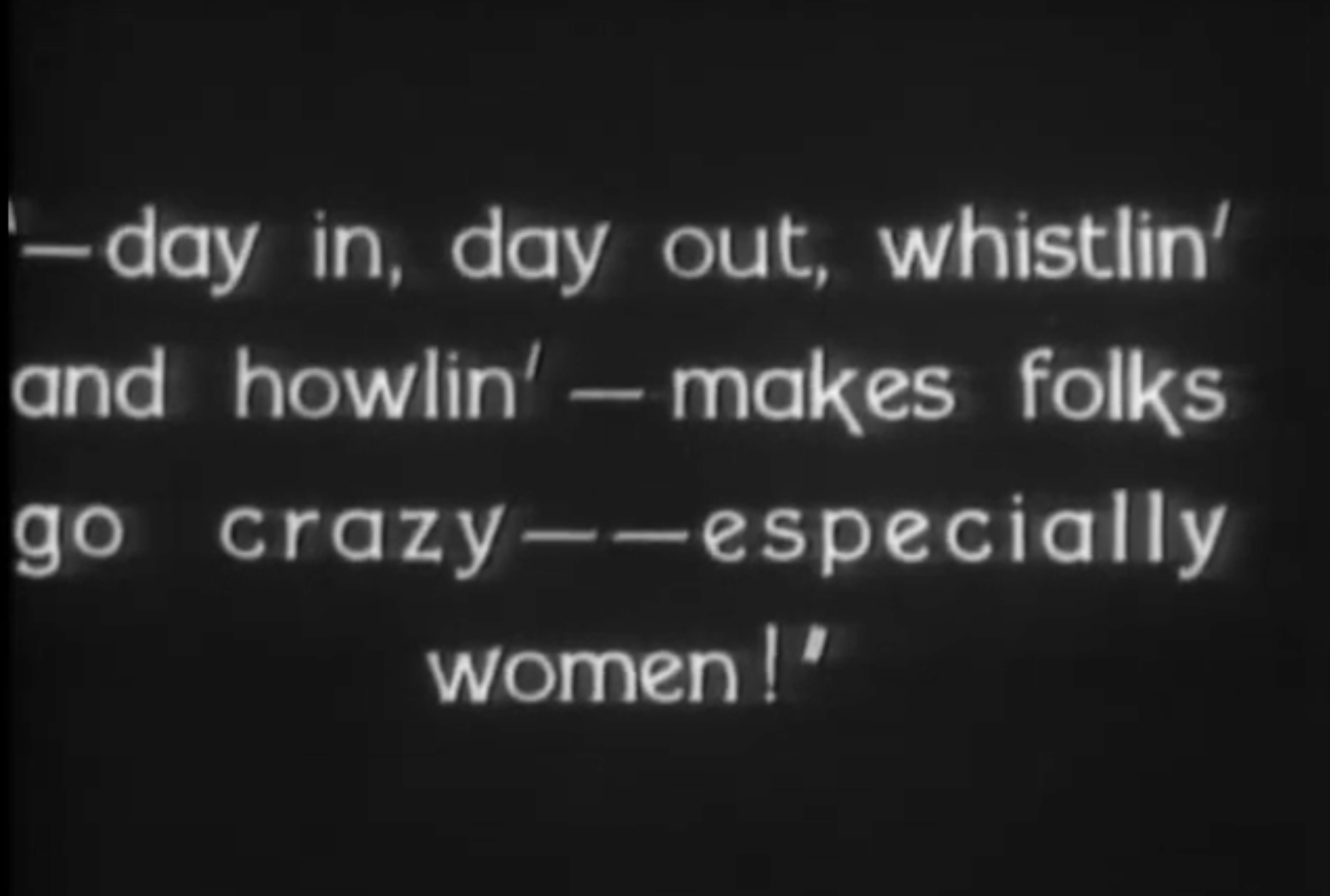
You do not need an online lip reader to understand when he says “Sweetwater?” And guffaws, “HaHAHa.” It is Roddy who explains that this region is the “‘land o’ the winds’” that “makes folks go crazy—especially the women!”
Almost immediately upon arrival in Sweetwater (where wind really is a sinus hazard, and the wind turbine industry boomed in recent years), Mason is accosted by three men, including Roddy, proposing marriage, and is a near-victim of a cyclone. Here we have the stakes: Men and weather pursue the innocent Mason until the movie’s climax when a formidable norther comes from the north, Wordy rapes her, and, in fear, she kills him.
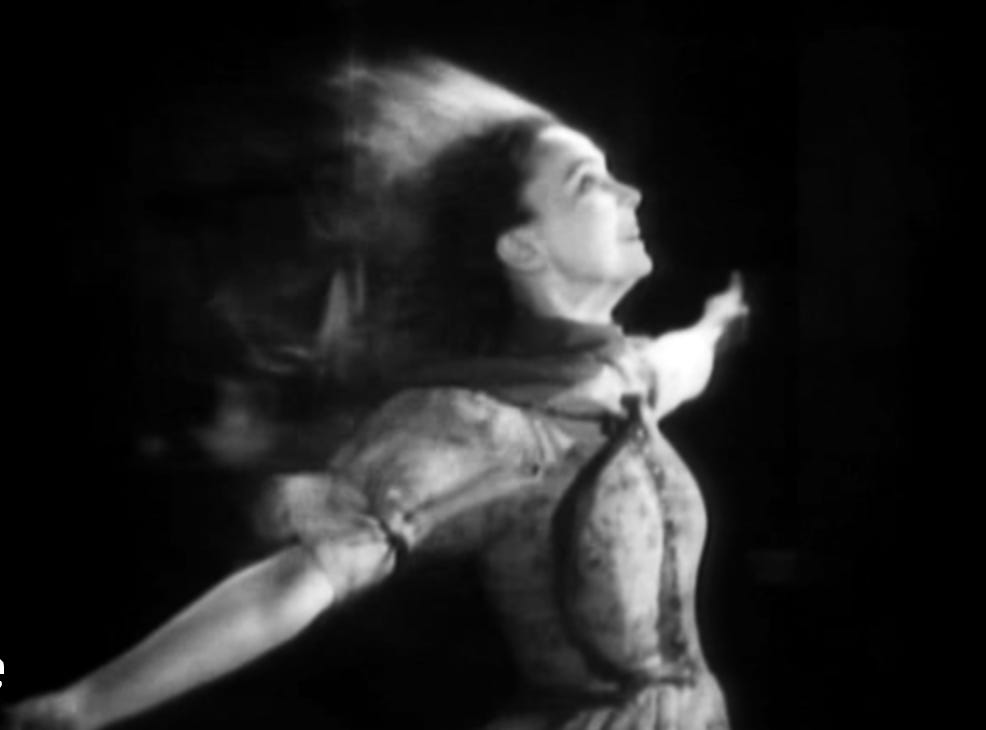
That is only the half of it. The picture is absolutely gorgeous, shot in black and white and composed with care, and the music is by turns eerie and beautiful. Long stretches of silence are broken by creaky hinge mews, howling violins, and occasional dusty coughs. The studio exec who greenlit the film told its lead actress: “Mr. Thalberg said we had a very artistic film, which I knew was a veiled punch,” and though he may have meant it as an insult, he was correct. The wind is clearly a giant metaphor for something.
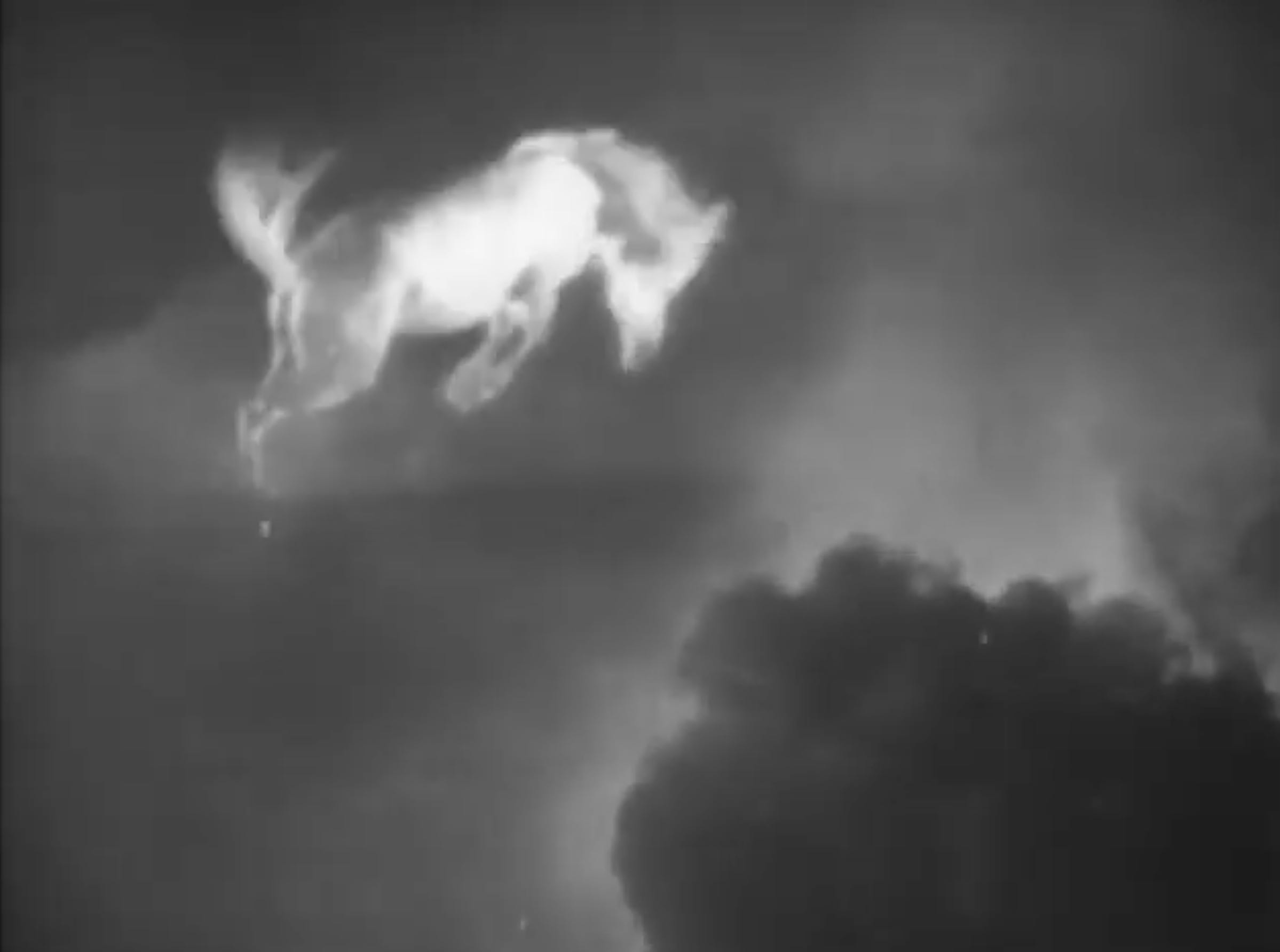
One 1920s critic wrote of the film’s heavyhandedness: “In the picture, the wind, whether it is a breeze or a cyclone, invariably seems a sham. . . during one of the early episodes she does her bit to accentuate the artificiality of this tale by wearing the worst kind of hat for a wind. [Director] Victor Sjöström hammers home his points until one longs for just a suggestion of subtlety. The villain’s sinister smile appears to last until his dying breath.” But for modern audiences, the black and white of it all, the simplicity, works to convey some sort of parable about the elements and man’s dominion over—or women’s submission to—them. Such a binary is also a motif of Westerns like this one: there are bad guys and good guys, sane and insane women, man versus nature. Also artful, I feel compelled to note, are the overlays of bucking and galloping horses; a Satanic, ghost version of the animal, in the Native American lore of the story, is the cause of norther winds.
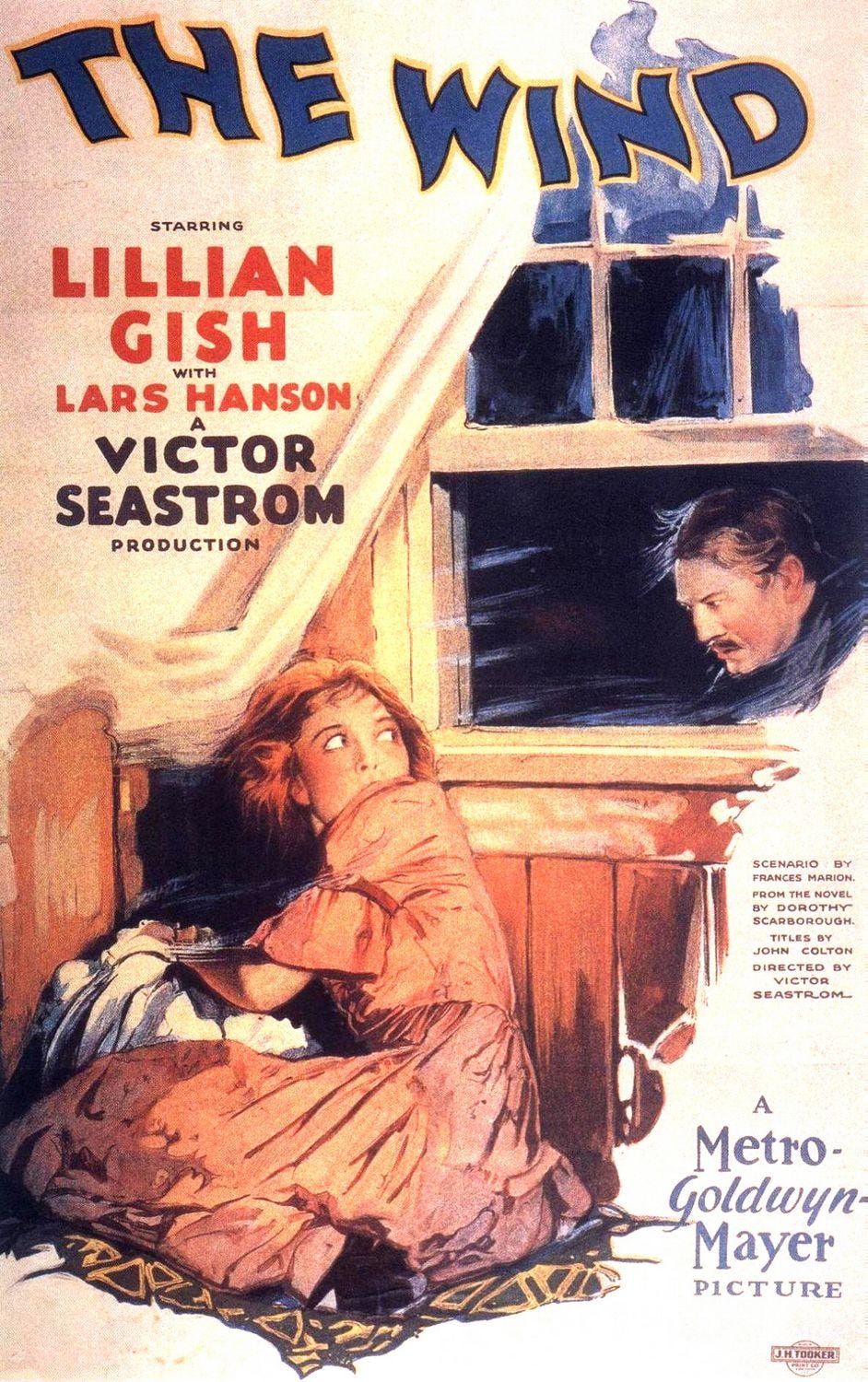
Though it takes place on the English moors, rather than a Western setting, the creeping atmosphere and strong winds brought to mind Wuthering Heights, another gothic revenge tragedy that reentered the public consciousness earlier this year. In that film, the wind isn’t a foe, but adds to the plot, the isolation, the insane behavior of its characters. (See also Wizard of Oz, a wind-induced fever dream, and Black Narcissus for themes of wind and sanity loss.) But like in Brontë’s book, a queasy uneasiness portends rampant abuse as the settings’ inhabitants slowly lose their minds. Both works also possess elements of the thriller/horror genre. Just as Cathy’s ghost haunts Heathcliff in the 1847 book, Mason at one point believes Roddy has risen from the dead to avenge himself. In the film’s poster, he hovers over her, watching on through a window.
And like Wuthering Heights, The Wind in novel form is a tragedy: Mason disappears into the desert wind after murdering her abuser. But for the movie, MGM ordered a happy ending, thus Mason falls in love with a man who promised to never rape her and lives happily ever after in the dust storms of Sweetwater, Texas. Somehow, despite this quaint conclusion, Texan audiences still took huge issue with the state’s portrayal in the film, though that reaction only served as “a tribute to its realism,” according to Texas folklorist J. Frank Dobie.
In every review of the film I could find, contemporaneous and modern, the wind is described as the catalyst of Letty’s mental disintegration. “The wind was the cause of it all,” the novel literally begins, and perhaps in the written work that’s true. But watching the film adaptation in the present day, I can’t see how the wind is at fault for anything other than conveying Mason across a Western landscape of leering men, and for heightening the stakes of her mad dash toward the story’s conclusion. Yes, there’s dust all over her bed, all over her plates, and sand that never stops blowing into the window of her cramped cabin, but what seems to actually be driving her insane is the discomfort of dodging multiple propositions before finally succumbing to her attacker. When she tries to escape Roddy, the wind pushes her back into his arms. After the violation has happened, it conveniently dies down. (Funnily, when men are caught behaving badly in the film, they fake innocence by brushing dirt off the lapels and sleeves of their suits.) In this way, this silent Western thriller, with its female protagonist, feels quite modern, having made use of the female abuse-revenge trope (see The Housemaid, starring Sydney Sweeney’s breasts, and Promising Young Woman by Emerald Fennell, of Wuthering Heights, the film). Affirming the righteousness of her violence—a very contemporary take— Mason’s love interest in the movie reassures her that the wind covers up a fallen body if “you kill a man in justice.” When she looks outside, Roddy’s body is nowhere to be seen.
And, if there is ever any doubt that the men of the film—and not the wind—were her true pursuers all along, consider one of her final lines of the movie, which comes after her rapist is dead and gone:
“I’m not afraid of the wind—I’m not afraid of anything now!”